

Hot Keyword:
Author:KUNYUAN Machine Manufacturer TIME:2026-08-30
A visible line is not a diagnosis. Its direction, width, repeat, face, roll position and response to finishing determine which evidence should be checked first. Preserve that map before settings or parts are changed.
Reliable references show why these symptoms need separate paths. CottonWorks identifies a needle line in double knit as a vertical-line defect associated with a bent needle, while its broader glossary distinguishes runs, dropped stitches, holes, unwanted tucking and other knit faults. Cotton Incorporated's barre bulletin defines barre as repetitive bars or stripes that commonly follow courses in circular knits and notes that yarn, physical structure and dye response can contribute. Groz-Beckert describes circular knitting as a system of needles and related parts and discusses longitudinal stripes associated with contamination and element behavior.
Use those examples as hypotheses, not remote diagnoses. Stop and secure the machine according to site and manufacturer procedures before any physical inspection; OSHA's guarding requirements reinforce that production urgency does not permit access to rotating or point-of-operation hazards. Mark the fabric, isolate one layer and perform an authorized correction only after evidence supports it. A restart is successful when a sufficiently long marked interval remains clear through the relevant finish, not when the symptom briefly disappears at the machine.
Lay out a full-width sample with machine direction and technical face identified. Record whether the fault follows a wale or course, appears as an isolated point, repeats at a fixed circumference, spans the width, changes after a stop or clusters near an edge. Note roll length, time, yarn lot, feeder or event marks and whether both faces show the same geometry. Use consistent lighting and compare greige with finished fabric where barre or color response is suspected.
Create separate records for vertical lines, holes and horizontal or coursewise bands even when they occur together. Their common timing may matter, but merging them into one complaint destroys useful geometry. Retain an unaffected reference and do not cut away the transition. The symptom map determines which material, knitting-element, delivery, take-down or finishing layer is examined next.
| Observed geometry | Evidence to collect | First isolation layer | Release requirement |
|---|---|---|---|
| Fixed vertical line | Wale position, both faces and repeat | Needle track, elements and contamination | Marked long interval remains clear |
| Hole or dropped area | Shape, event, yarn path and handling | Loop event versus downstream damage | No recurrence through finish |
| Coursewise barre band | Band map, lots, feeders and lighting | Yarn, loop geometry and dye response | Matched greige and finished proof |
| Mixed or changing fault | All transitions and prior actions | Return to last observable baseline | One attributable correction at a time |
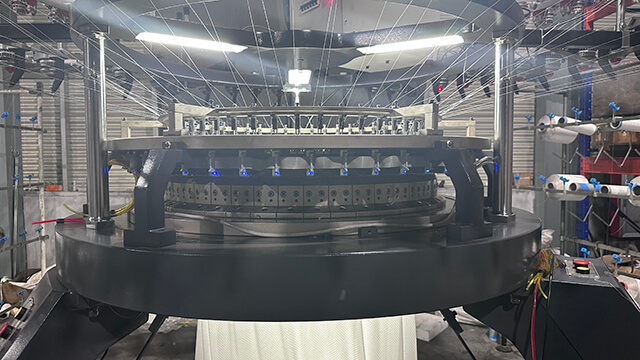
A persistent vertical line can direct attention to a fixed needle-track position, but inspection must remain broader than one example. Under safe isolation, qualified staff compare suspect and neighboring needles, sinkers or related parts for damage, wear, contamination, seating and compatibility with the cylinder or dial. Preserve replaced parts and record their positions. Check whether the line follows one machine location, migrates with yarn or disappears after cleaning.
For holes, distinguish an isolated puncture, a dropped or missed loop path, yarn break event, press-off boundary and damage created in handling or finishing. Review yarn imperfections, delivery interruptions, guides, stop history, element condition and downstream contact points without changing all of them together. If a part is replaced or a yarn path corrected, mark that exact transition on the roll. This allows the new interval to prove which layer changed.
Map the band width and recurrence against packages, feeders, lots, machine events and roll length. Compare technical face and back under consistent light, then inspect transmitted light where useful for distinguishing a physical density difference. Keep yarn count, twist, evenness, moisture or dyeability records with the package map when available. A coarse or differing yarn can contribute to a band, but the appearance alone does not prove that diagnosis.
Compare greige and dyed or finished samples from the same coordinates. A band visible in structure before dyeing suggests a different path from variation revealed only after color processing. Review delivery and loop-length evidence, take-down, temperature or process history and finishing records as separate layers. If packages or feeders are exchanged under a controlled plan, preserve the before-and-after map. Do not make broad tension changes merely because the symptom is horizontal.
Choose the narrowest safe action supported by the investigation: replace a confirmed damaged element, clean an identified track, correct a documented yarn path, segregate a suspect lot or route matched samples through process review. Record who authorized the work and follow the delivered service procedure. Keep guards and interlocks in their intended state. A correction that cannot be described and repeated is not a controlled fix.
Mark restart position and knit long enough to cover warm-up, the former repeat interval and a normal production event. Inspect the complete width and both faces, then carry a matched section through the finish that previously revealed the defect. Reconcile accepted and held material and update maintenance or material-control records only where the evidence supports it. If the symptom returns or changes geometry, reopen the map rather than stacking another adjustment.
No. A bent needle is one documented example; contamination, wear, system-part condition, yarn path and other fixed-position causes require evidence.
The surrounding loops, event position and technical faces help distinguish a knitting interruption from later handling or finishing damage.
Barre commonly appears as repetitive coursewise bars or stripes, but its physical, yarn and dye-related causes still need controlled comparison.
No. Multiple simultaneous changes remove attribution and may create another defect. Preserve a baseline and alter one supported layer.
After a marked interval covers the former repeat and normal events, passes full-width inspection and remains acceptable through the relevant finishing route.
Circular knitting troubleshooting improves when the fabric remains the investigation map. Vertical lines point toward fixed-position evidence, holes require loop-event and handling separation, and barre calls for coursewise yarn, structure and dye comparisons. One safe, recorded action followed by a marked restart preserves cause and effect. That discipline reduces repeated adjustment while keeping the final decision tied to accepted fabric.
Use the symptom-isolation record when reviewing service evidence for a Circular Knitting Machine and keep all physical inspection within the manufacturer's guarded maintenance procedure.

 Tel: +86-13859034518
 Email: info@kunyuanmachine.com
 MP/WhatsApp: +86-13859034518
 Manufacturer Address:Bacuo Village, Yonghe Town, Jinjiang City, Fujian Province