
Language
Hot Keyword:
Author:KUNYUAN Machine Manufacturer TIME:2026-11-19
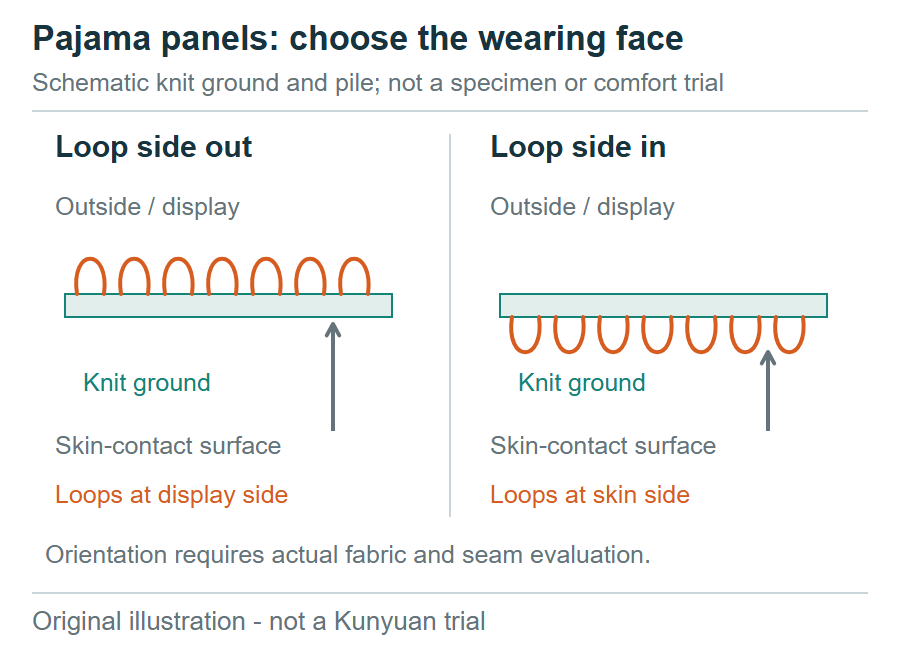
Choose the skin-contact and display faces before cutting terry pajama panels. Kunyuan's computerized terry listing names pajamas, but suitability depends on the actual loop surface, pattern and seams. Compare the proposed orientation on a complete garment instead of assuming that a soft-looking swatch will feel the same when worn.
Kunyuan's public computerized terry page, read on October 11, 2026, lists 30-38 diameter, 12G-24G and 36F/54F and names reverse/polar and velour/ordinary terry configurations. Pajamas appear in its end-use text. These are catalogue descriptions, not a wearer trial or evidence that every listed combination is supplied.
Groz-Beckert describes circular-knitted continuous tubes; a fabric tube still needs the chosen garment route. Coats emphasizes the combined requirements of skin-contact seams. The useful development choice is therefore which fabric face serves which role and how the panel, trim and joining operations preserve that choice.
If the design uses the loop surface outside, identify the intended visible pattern on that side and label the reverse as the proposed skin-contact surface. Inspect the actual finished specimen with its face designation intact. A supplier's ordinary or reverse terry label does not replace that identification; the offered configuration and finish must produce the requested orientation.
Make a complete pajama-top sample with the actual shoulder, side and sleeve seams. Review the contact surface at seams as well as at the center of a panel. The garment maker should demonstrate how the visible loop surface is handled at cut edges and around trim. Do not assume that an attractive outside surface removes interior ridges or establishes sleeping comfort. Those are separate observations on the assembled garment.
If the design places loops inside, review the actual surface against the intended contact experience. Ask whether the buyer wants a pronounced loop, a modified finish or another offered construction. Keep the request descriptive until a fabric is supplied; a machine-family name cannot choose the hand of a particular pajama.
Inspect the display side and its pattern too. Reversing a fabric may change which effect is visible, so the artwork and garment design must agree with the orientation. Compare the proposed neckline, sleeve joins and hem on the complete top. Folded or doubled regions can put an unexpected surface against the wearer. A route that works in the broad body area may still need a different trim construction at the opening.
Mark the approved face and fabric direction before the garment maker prepares the cutting plan. Keep fronts, backs, sleeves and trim identified so the correct side reaches the sewing operation. CottonWorks separates garment cutting from trim preparation and assembly; that is a useful reminder that a fabric approval is only the starting material.
Check whether paired sleeves or other mirrored pieces retain the intended surface orientation. Where the design has a visible directional effect, ask the cutter to demonstrate it on a full set of parts. Do not infer a one-way rule from a generic texture photograph. The relevant direction is the one observed on the actual finished fabric. Examine a sewn sample before scaling the cut quantity, especially when a turned hem or facing exposes the opposite side.
Keep the same garment pattern for the comparison wherever feasible, and disclose changes needed by one construction. Have the sewing team examine seam extension, bulk and feel on the actual fabric. Coats' guidance supports that combined assessment, but its thread examples are not a universal pajama recipe. Choose sewing details through the responsible garment maker's trial.
Reinspect the contact face, visible pattern and seam presentation after the agreed garment-care route. Record the condition and retain both original and cared-for examples. This is a proposed product-development comparison, not a medical, thermal or certified comfort test. If the buyer has an objective performance requirement, agree its assessment separately. Select the route whose whole garment matches the brief rather than approving a surface adjective such as soft.
| Decision | Loop side outside | Loop side inside | Evidence needed |
|---|---|---|---|
| Display | Visible loop/pattern face | Opposite visible face | Labeled finished specimen |
| Contact | Reverse against skin | Loop surface against skin | Complete garment review |
| Cutting | Keep face assignment | Keep reversed assignment | Identified component set |
| Joining | Check interior ridge | Check loop-side join | Actual seams after agreed care |
No. It establishes a catalogue application. Evaluate the exact fabric, orientation and assembled seams for the buyer's requirements.
Do not assume so. Ask which configuration and finish create the requested skin-contact and display surfaces.
The listed fabric route does not establish that. Cutting, trim and assembly must be specified separately.
The finished fabric's face designation, complete component set and a sewn garment using the actual joining route.
A terry pajama enquiry is clearer when it begins with the wearing face. Connect that face to the visible pattern, every cut component and the actual seams, then compare the complete garment through its intended care. Catalogue applications help start the conversation; an identified assembled sample resolves the orientation choice.
Start the pajama-fabric discussion with the Computerized Jacquard Circular Knitting Machine catalogue and request the exact terry configuration for the chosen face route.

 Tel: +86-13859034518
 Email: info@kunyuanmachine.com
 MP/WhatsApp: +86-13859034518
 Manufacturer Address:Bacuo Village, Yonghe Town, Jinjiang City, Fujian Province