

Hot Keyword:
Author:KUNYUAN Machine Manufacturer TIME:2026-09-08
Marks that appear oily may originate at lubrication, yarn preparation, handling, take-down, storage or wet processing. Preserve where and when the stain appears before cleaning the machine or changing several settings.
Stop the affected roll from losing its coordinates. Mark machine direction, technical face, start time, course position, full circumference and every intervention. Photograph the mark under fixed light and retain an untreated sample. Record oil product and batch, delivery or refill history, approved application method, machine state, yarn lots, package positions, operator handling and downstream process. Do not diagnose from color or touch alone.
Manufacturer guidance treats needle oil as a system-specific material whose behavior and washability can be evaluated; it does not provide one universal oil or dose for every machine and fabric. Adjustments inside guarded or moving areas belong to qualified personnel following exact documentation. The editorial method here is evidence isolation: compare position, timing and process response, change one supported layer, then carry marked fabric through the commercial finish.
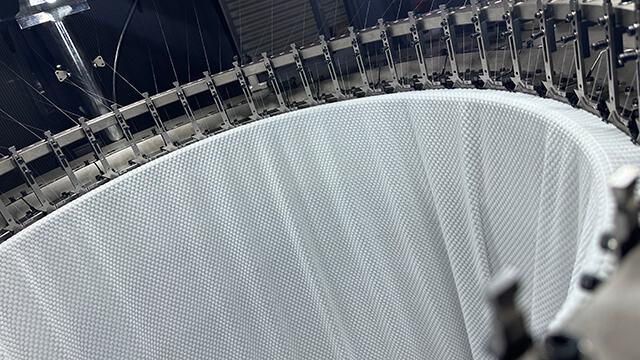
Classify the mark as fixed to a wale, recurring around the circumference, following roll edges, scattered by package, or appearing only after handling. Compare technical face and reverse, adjacent fabric and the same roll before and after the event. A fixed machine-coordinate pattern and a random splash require different inspections.
Measure the repeat using the mill's fabric coordinate system and link it to time, feeder, shift and roll identifier. Protect the original section from washing or solvent tests until a controlled sample plan exists. A photograph without direction and scale cannot support a machine-location hypothesis or later comparison.
| Observed pattern | Likely evidence layer | Controlled comparison | Do not conclude from |
|---|---|---|---|
| Fixed wale or repeat | Machine position and timing | Marked circumference | Color alone |
| Package-linked scatter | Yarn lot and path | Suspect vs reference package | One cleaned spot |
| Edge or roll mark | Take-down and handling | Roll-path inspection | Machine oil record only |
| Appears after finish | Washability and chemistry | Labelled process samples | Greige appearance |
Verify the approved lubricant designation, supplier batch, storage, fill or change date and any mixed or substituted product. Record automatic-system status or manual application exactly as permitted by the machine instructions. Inspect observable leaks, collection points and abnormal consumption without bypassing guards.
Compare the stain event with maintenance, refill, cleaning, prolonged stop and restart. An increase in use can reflect leakage, delivery changes or recording errors; it is not a license to reduce lubrication below documented requirements. If the product identity or system condition is uncertain, hold the trial and involve the lubricant and machine specialists.
Retain suspect and comparison yarn packages with their positions. Review package oil or finish, winding condition, guides, operator contact, floor or trolley exposure, take-down and roll wrapping. Sample handling can transfer contamination after knitting, while a process chemical can create a mark that resembles machine oil after heat.
Use controlled blanks and identified fabric pieces through the actual scouring, dyeing or finishing route. Do not apply unapproved chemicals to production fabric or claim chemical identity from a visual result. A qualified laboratory may be required when the source remains ambiguous or the commercial consequence is high.
Choose the correction supported by the strongest evidence, such as restoring the approved oil identity, repairing a confirmed leak, correcting documented delivery, isolating a package lot or changing a handling practice. Record who performed it and where the roll transition occurs. Avoid simultaneous cleaning, oil, yarn and setting changes.
Run long enough to cover the former repeat, normal stop and restart, then inspect the full circumference. Finish marked before-and-after pieces together under a controlled route. Close the fault only when the original stain geometry is absent, no new defect appears and lubricant requirements remain satisfied.
No. Yarn finish, handling, take-down, storage and wet processing remain plausible until evidence separates them.
No. Follow the exact machine and lubricant requirements; inadequate lubrication can damage knitting elements.
It preserves the original geometry and allows controlled comparison with washing or laboratory results.
Not by itself. It can compare response under a stated process; specialist analysis may be needed.
After one supported correction removes the repeat through the commercial finish without creating another defect.
Oil-stain diagnosis is strongest when fabric coordinates, lubricant records and competing process layers stay visible. The goal is not to make the mark disappear during inspection; it is to prove which condition created it and show that a controlled correction survives finishing. This evidence also protects lubrication needs from an unsafe trial-and-error response.
Use the evidence map with the exact lubrication documentation for the circular knitting machine range and keep chemical or guarded service work with qualified personnel.

 Tel: +86-13859034518
 Email: info@kunyuanmachine.com
 MP/WhatsApp: +86-13859034518
 Manufacturer Address:Bacuo Village, Yonghe Town, Jinjiang City, Fujian Province