Hot Keyword:
YOUR POSITION:HOME > Blog >

Four- or Six-Feed Pique on a Single Jersey Circular Knitting Machine?

Author:KUNYUAN Machine Manufacturer TIME:2026-11-16

MENU
Pique repeat planning

A textured cell needs a repeat that the offered build can reproduce

Choose a pique setup by its knit-and-tuck repeat, then check how that repeat fits the active knitting systems. Kunyuan's listed 102-feeder single-jersey model is a useful starting point, but the feeder total alone cannot confirm either a four-feed or a six-feed construction.

The public Kunyuan model table, read on October 11, 2026, lists a 34-inch diameter, 26G and 102 feeders. These are catalogue coordinates, not results from a pique trial. The category also mentions pique among its apparel applications. Ask for the exact needle grouping and cam proposal for the texture you intend to buy.

CottonWorks distinguishes four-feed single pique from a six-feed alternative. Groz-Beckert's fabric-structure course connects analyzing a construction with developing its cam table. Together they support a practical question: can the offered build reproduce the requested cell, including the transition from the final active feed back to the first?

Repeat coordinates

Count the feeds used by one structural repeat, then ask how the supplier maps that repeat around the proposed machine. A feeder total cannot identify the available knit and tuck actions.

01

Describe the cell rather than ordering generic pique

Send a labeled face and back sample with a simple loop notation. Identify the selling face, the cell arrangement and the feeds belonging to one complete repeat. A supplier and buyer can use the same fabric name for different textures; the notation gives them something concrete to compare. Keep the requested construction distinct from a photograph's lighting or surface finish.

The four-feed and six-feed examples are different structural sequences, not two speed settings for one fabric. Do not substitute one simply because its cell looks similar on screen. Ask the supplier to mark where each needle group knits, holds a loop or receives a tuck. That explanation should refer to the actual proposed cam arrangement, rather than an unrelated machine's pattern catalogue.

02

Use feeder arithmetic to expose an unresolved layout

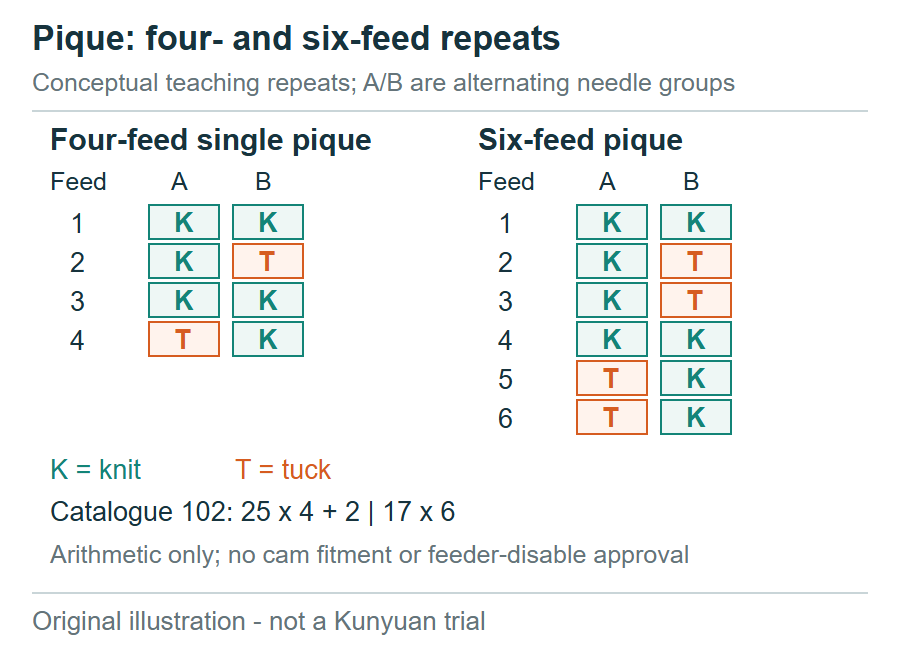
Separate the listed feeder count from the systems that will actually knit the proposed structure. As an arithmetic illustration, 102 contains seventeen groups of six, while twenty-five groups of four use 100 and leave two. Those divisions raise an allocation question; they do not establish that the machine can run either arrangement.

For a four-feed proposal, request the supplier's complete around-machine map and explanation of any unused or differently assigned systems. For a six-feed proposal, exact divisibility still leaves needle selection and cam compatibility to prove. Inspect the repeat boundary as well as the middle of the map. Only the responsible supplier should determine permissible feed use and configuration changes; this calculation is an enquiry aid, not an instruction to disable feeders.

03

Check the finished cell against the garment brief

Choose the texture for a reason the garment team can explain: a finer visual cell, a more pronounced surface or a particular face appearance. Inspect both candidates with the intended yarn and finish. The visible openings and raised areas can change how color, embroidery or a placket appears, so include a representative garment component rather than judging only an isolated swatch.

Record the same viewing conditions and relaxed fabric state for the comparison. A darker photograph does not prove a deeper cell, and a six-feed description does not certify airflow or comfort. If breathability is a purchase requirement, agree a suitable laboratory assessment separately. Keep the structural identity with the specimen so the buyer can tell whether an attractive finish concealed a substitution in the underlying repeat.

Look for an interruption where the machine map closes

Ask for a fabric sample long enough to inspect repeated cells around the fabric circumference and across successive pattern cycles. Mark the location corresponding to the supplier's final-to-first system transition. Compare cell alignment there with an ordinary section. A narrow showcase strip may omit the very location where an allocation mismatch becomes visible.

Agree the acceptable texture and any repeat discontinuity before placing the order. Keep the cam proposal, active-system map and accepted specimen together, then request the same construction in a subsequent sample. This is a structural demonstration, not a claim of production speed or dyeing consistency. Where the supplier proposes a different repeat to suit the build, return that change to the garment designer before accepting it as an equivalent pique.

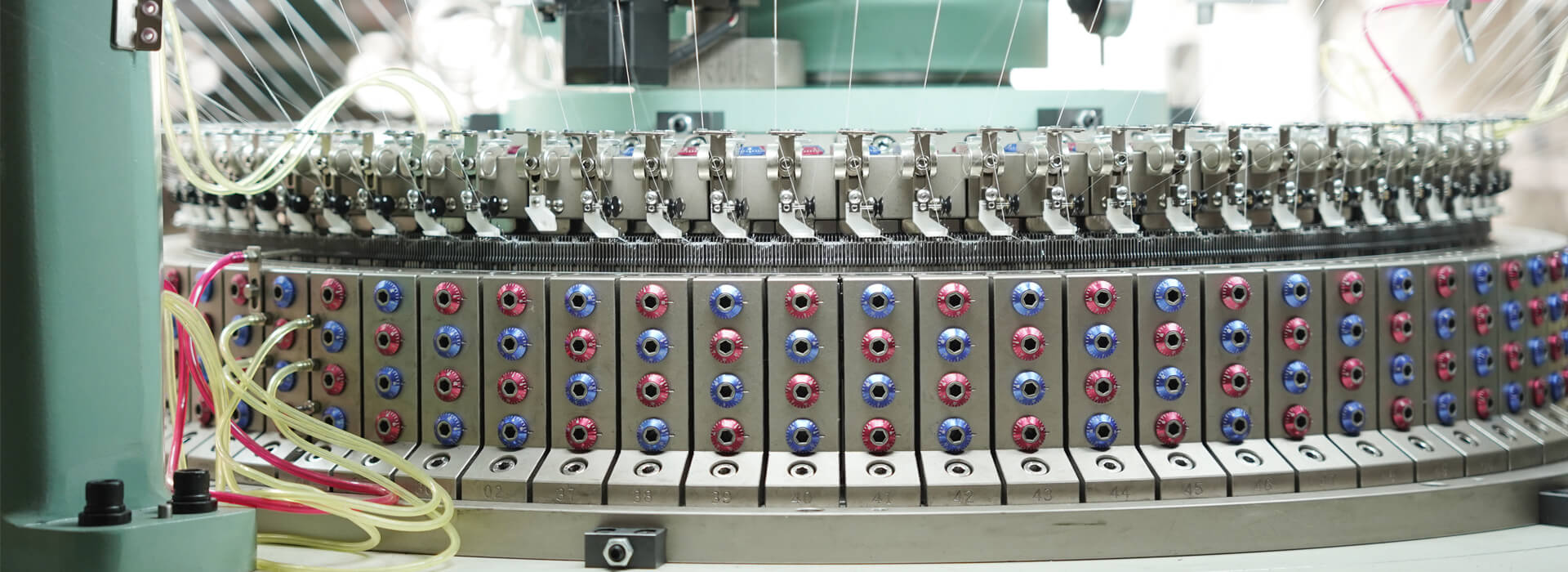
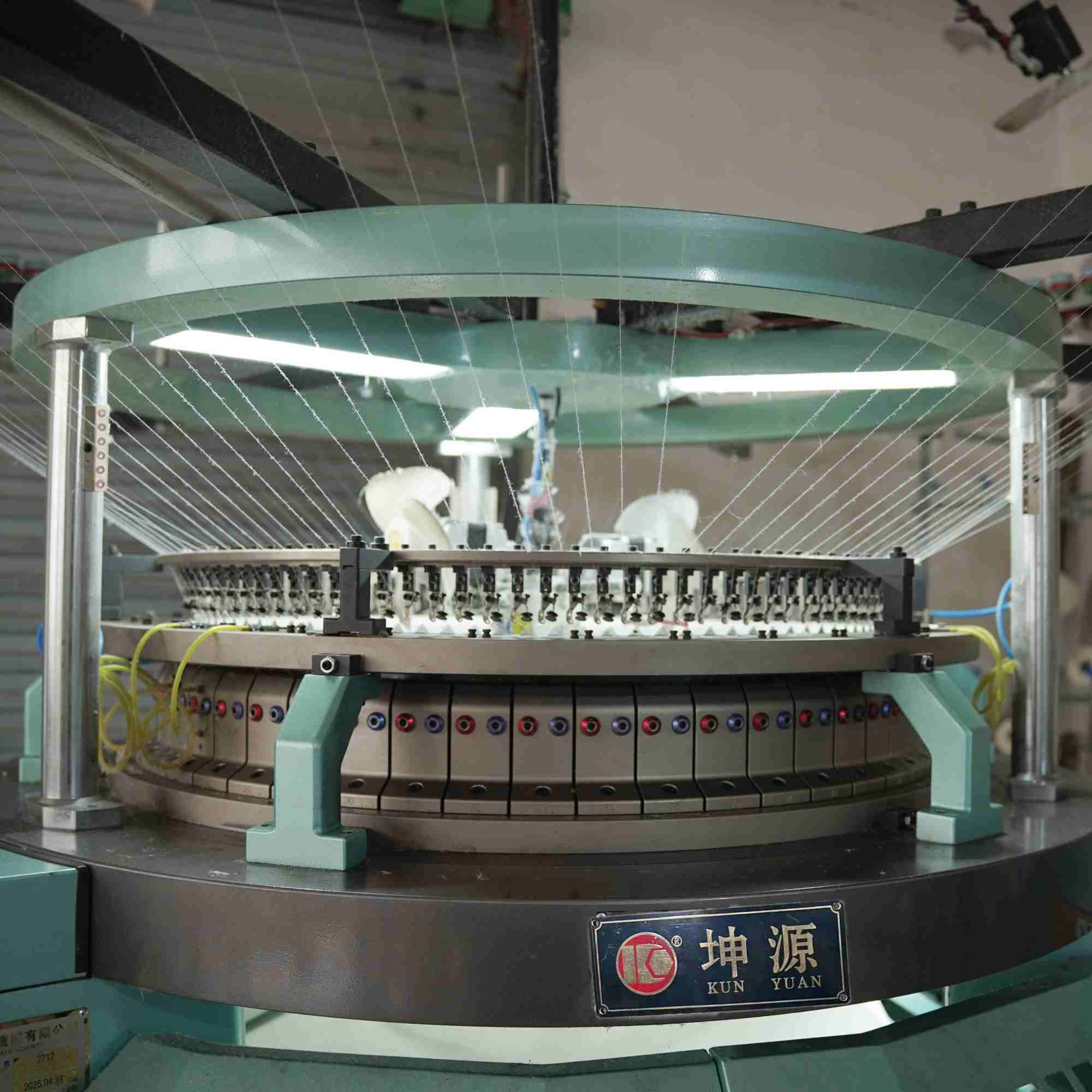
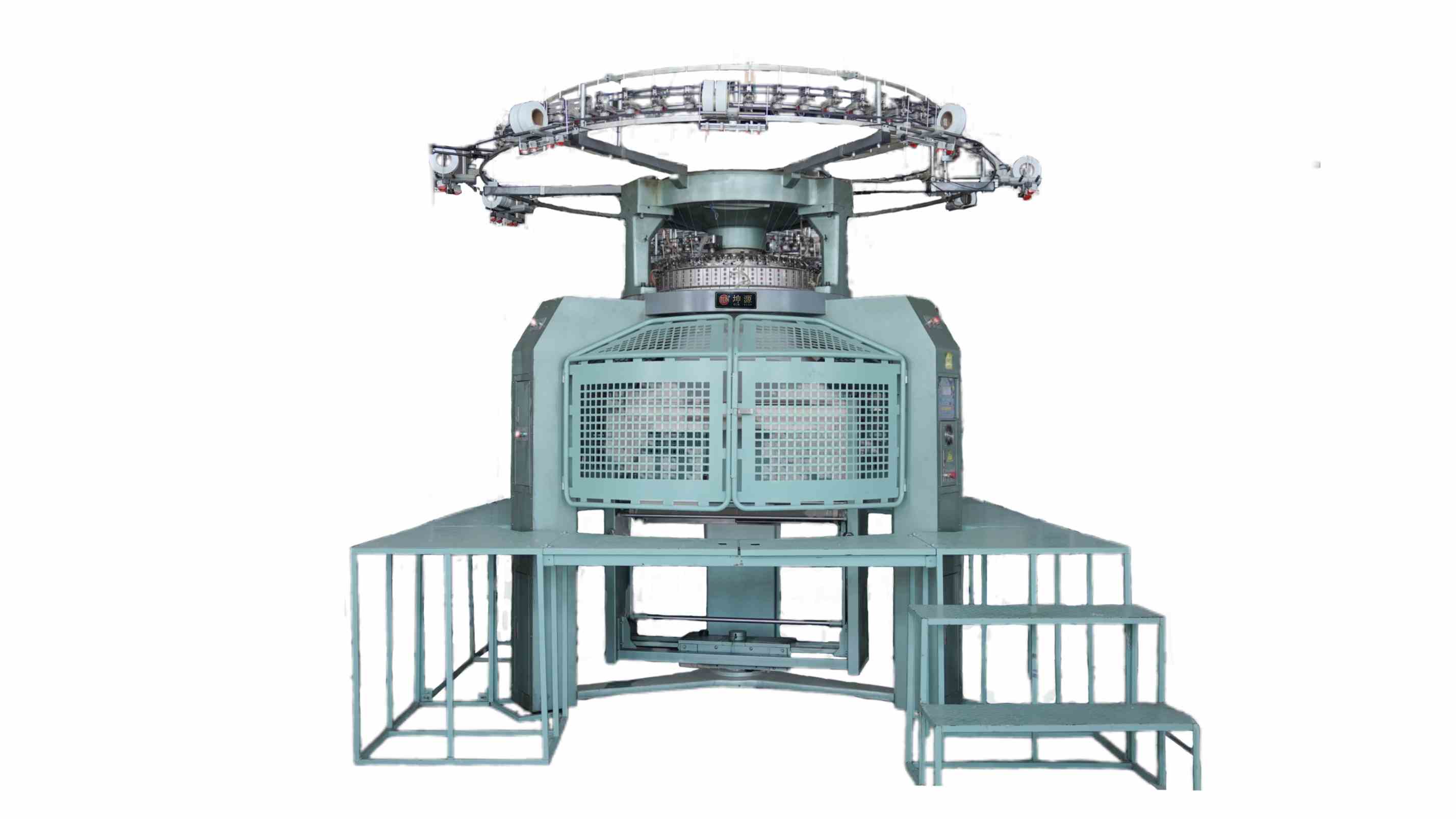
Kunyuan 34-inch single-jersey machine catalogue view
Product context for the 34/26/102 enquiry; no pique trial is shown.

Pique repeat enquiry map

QuestionFour-feed exampleSix-feed exampleSupplier response
Structural repeatFour feedsSix feedsActual loop notation
102-feed arithmetic25 groups plus two positions17 groupsPermitted active-system plan
Needle actionRequested knit/tuck sequenceRequested knit/tuck sequenceCam and needle-group mapping
Finished evidenceNamed face and cellNamed face and cellBoundary-inclusive specimen
Four-feed K/K, K/T, K/K, T/K rows beside six-feed K/K, K/T, K/T, K/K, T/K, T/K rows, with knit/tuck legend and bounded 102-feed arithmetic.
Original illustration. Original teaching diagram of four- and six-feed pique knit/tuck repeats; 102-feeder divisions are secondary arithmetic, not a Kunyuan cam setup or trial. Kunyuan editorial; not a Kunyuan trial.
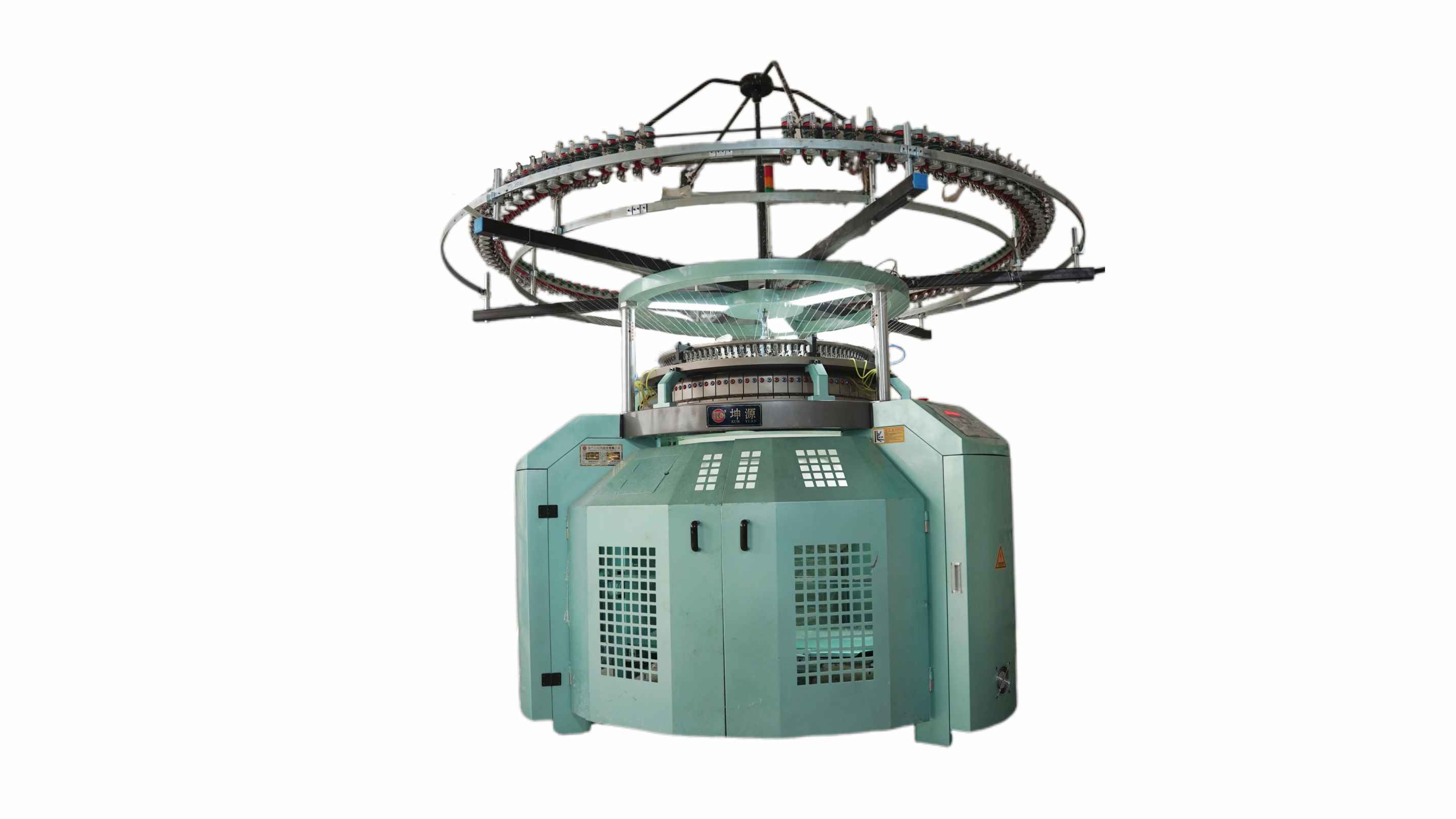
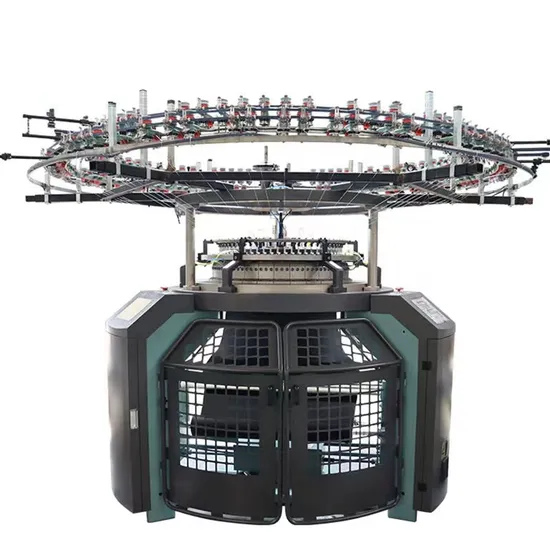
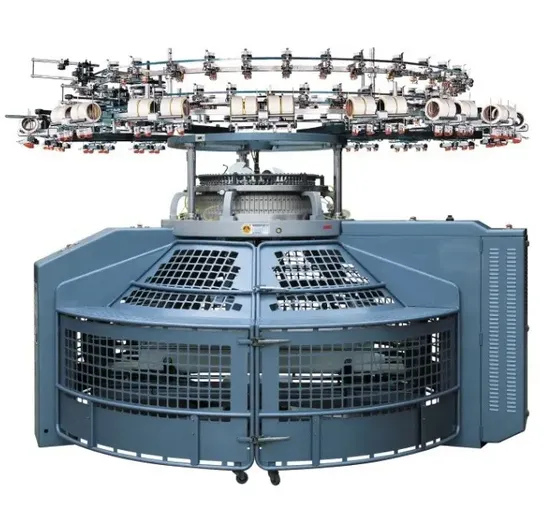
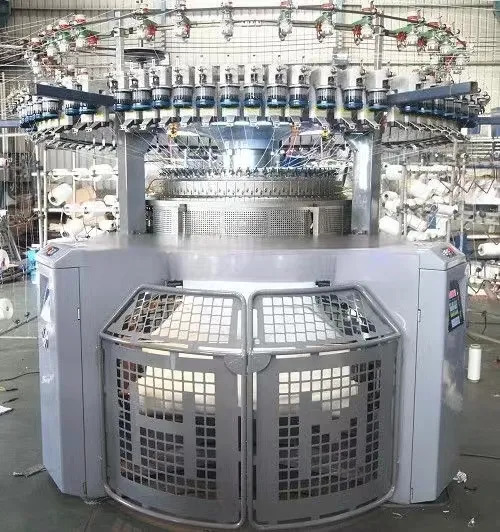
Kunyuan single-jersey complete machine gallery reference
A machine photograph cannot establish the finished cell or repeat closure.

Pique repeat questions

Does 102 feeders prove six-feed pique capability?

No. Divisibility only checks one arithmetic relationship. The supplier must confirm the necessary needle actions, cams and complete repeat mapping.

Can two feeds simply be turned off for four-feed pique?

Do not assume that. Ask the supplier for an approved active-system arrangement and its fabric evidence.

Is six-feed pique automatically better for a polo?

No. Choose the cell and surface for the garment design, then assess the actual finished fabric.

Which face should the buyer approve?

Name the selling face in the brief and retain a labeled face/back sample; different pique constructions can present their texture differently.

What should accompany the fabric sample?

Its loop notation, active-system map, yarn identity, finishing state and the location of the repeat transition.

Conclusion

A pique quotation becomes useful when the requested cell has a clear construction and a feasible around-machine map. Use feeder arithmetic to find missing explanations, then choose the finished texture with the garment team. Approve the demonstrated repeat rather than treating the catalogue feeder total as a fabric guarantee.

Start with the Single Jersey Circular Knitting Machine range and request a model-specific pique repeat and cam proposal.

Need Help?
Please leave your contact information to get our latest catalog
Get In Touch Now >
Kunyuan Machinery Manufacturer

Tel: +86-13859034518

Email: info@kunyuanmachine.com

MP/WhatsApp: +86-13859034518

Manufacturer Address:Bacuo Village, Yonghe Town, Jinjiang City, Fujian Province

NEW KEYWORD

About Us

Products

Information